
New nurse orientation tracking: a system that survives six orientees at once
Orientation frameworks are everywhere — phases, competencies, preceptor models. What's missing is the mechanics: how one educator actually keeps six concurrent orientees straight across different units, start dates, shifts, and preceptors, week after week. This guide is the mechanics.
The unit of tracking is the orientee-week
Frameworks describe orientation as phases; the work arrives as weeks. The question you must be able to answer for every orientee, every week, is the same: where are they, who's with them, and are they on track? So track at the orientee-week level, not the phase level. A phase is a summary; a week is a fact.
The per-orientee record
One card or row per orientee, holding:
- Identity & context — name, role (RN, new grad, experienced new hire), unit, shift, start date
- Track — which orientation template applies (new grad vs experienced hire vs cross-training differ in length and checkpoints)
- Preceptor(s) — current assignment, and whether the schedule actually pairs them this week (the silent killer of orientation quality is orientee and preceptor scheduled apart)
- Phase & expected week — where the template says they should be
- Requirement status — which templated items (skills, modules, check-offs) are done, due, or overdue, including what the LMS shows
- Contact cadence — when you last connected with the orientee, and when you last heard from the preceptor
- Flags — anything that changes the plan: extended phase, schedule gap, struggling skill area
Two dates do most of the work: last educator contact and expected phase week. Staleness on either one is your early-warning system.
The weekly review (per orientee, two minutes)
Same rhythm as every queue that works — a fixed weekly pass. For each orientee: (1) Does actual week match expected week? (2) Did they work with their preceptor this week — and if the schedule split them, who's fixing next week? (3) Any new requirement now due? (4) When did I last talk to them — beyond a hallway wave? (5) Anything the preceptor said that needs action? Six orientees, question set above — that's a 15-minute weekly habit that replaces the end-of-orientation surprise.
Red flags that mean escalate, not observe
- Two consecutive weeks behind the expected phase with no documented reason
- A preceptor mismatch that keeps recurring (schedules never overlap)
- The same skill area flagged in two different weeks
- No educator contact for two weeks (that's a you-flag — the system should make it visible)
Escalation here means moving from tracking to a structured conversation with the preceptor, manager, or program per your facility's process — the tracker's job is making sure that conversation happens in week four, not week eleven.
Make it survive handoff
Orientation records outlive vacations and role changes. Write the record so another educator could pick it up cold: no private shorthand, dates on everything, flags in words ("needs 2nd med-pass check-off, ask preceptor") rather than highlighting. If your tracking lives in a binder today, this is the strongest argument for structured rows.
Where an app fits
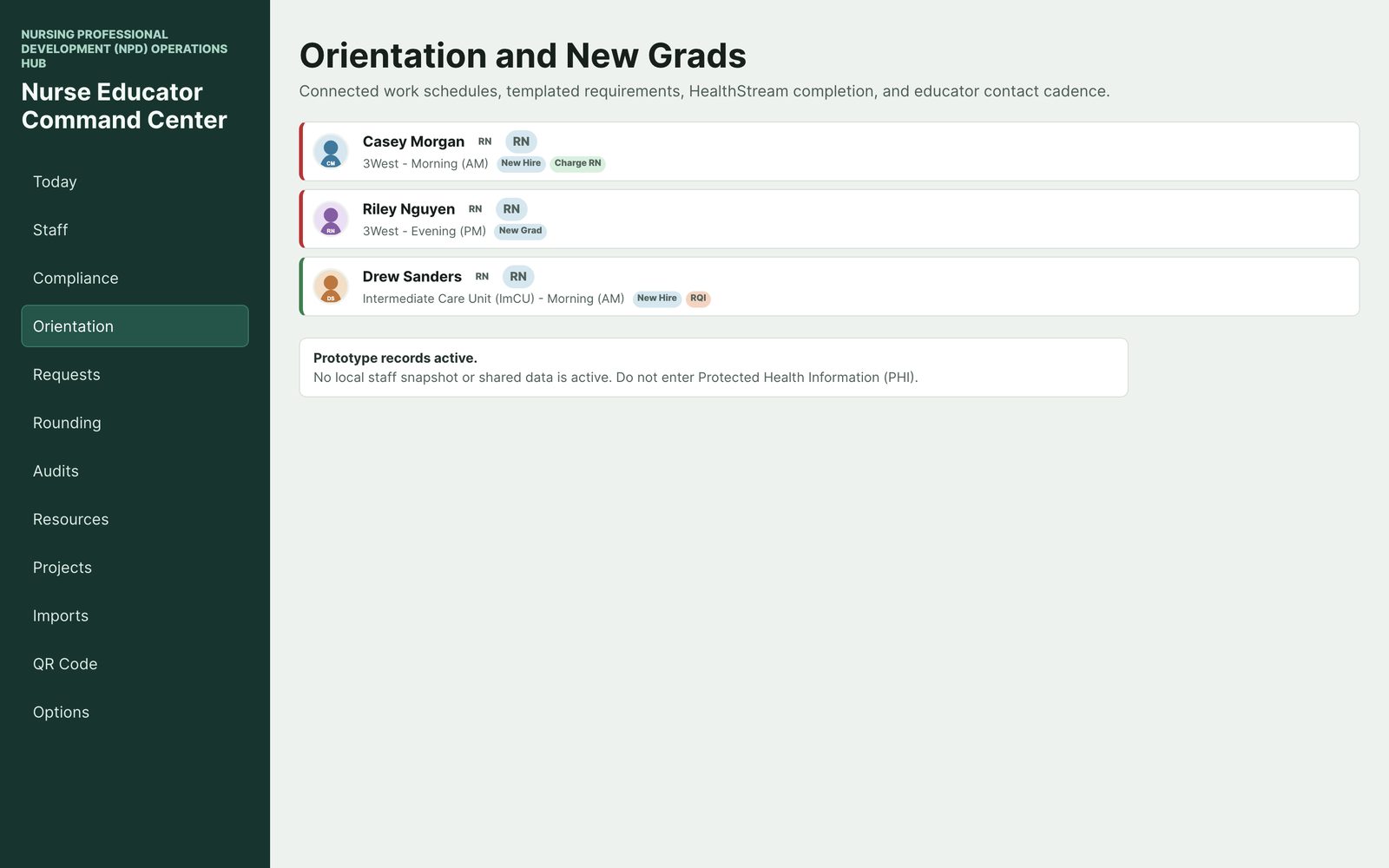
Nurse Educator Command Center has an Orientation module built on this record: orientees as cards with unit, shift, and tags like New Grad — connected to work schedules, templated requirements, LMS completion state, and your contact cadence, so the weekly review reads off one screen.
FAQ
How many orientees can one educator realistically track?
There's no universal number — it depends on role mix and how much of orientation you personally deliver. The system above is what keeps the number honest: when weekly reviews start getting skipped, you're past capacity and it's data for your manager, not a private failing.
Who owns the checklist — educator or preceptor?
The preceptor owns observation and sign-off at the bedside; the educator owns the record, the cadence, and the escalation. Trouble starts when the record and the bedside stop talking — which is what the weekly preceptor question prevents.
Do new grads and experienced hires need different tracking?
Different templates (length, checkpoints, skill sets) — same mechanics. The record and weekly review don't change; the Track field is what absorbs the difference.