
How to track staff education compliance without losing your weekends
"Compliance" sounds like a report someone else runs. On the unit it's concrete: whose certification lapses next month, who never finished the annual module, and which of those people you've already chased twice. Here's a tracking system that answers those questions on demand — the fields, the risk ladder, and the loop that actually closes.
Why the LMS report isn't enough
Your LMS is the system of record for assigned learning, and it's good at that. But educators live in the gap between assigned and assured: the LMS shows a completion, while the card, the sign-off sheet, or the observed check-off lives somewhere else — or nowhere yet. It also can't tell you what you've done about a lapse: who you reminded, when, and what they said. Tracking compliance means tracking three things at once — the requirement, the proof, and the follow-up. That's yours to hold. The tracker below holds it.
The tracker: one row per person-per-requirement
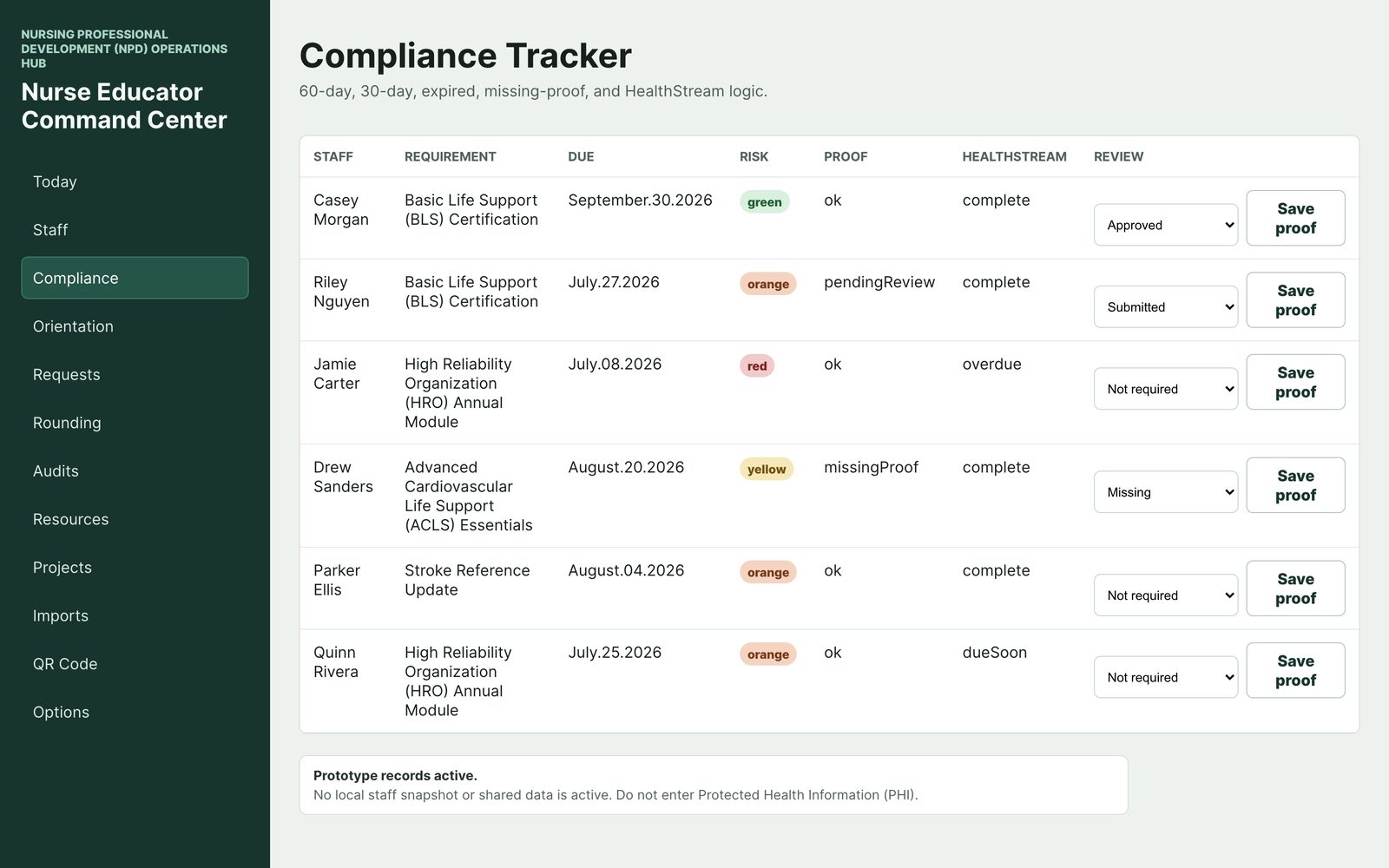
Not one row per person. Casey with BLS and Casey with the annual stroke module are two rows, because they have different due dates, different proof, and different risk. Columns that earn their place:
- Staff member (and unit, if you cover more than one)
- Requirement — BLS, ACLS, annual modules, unit-specific competencies
- Due date — a real date cell, not "September"
- Risk — computed from the due date (next section)
- Proof status — e.g., ok / pending review / missing
- LMS status — what HealthStream (or your LMS) shows, recorded at last check
- Review state — approved / submitted / missing / not required
- Last follow-up — date + one-line note
That last column is the difference between a list and a system: it's what makes the tracker answer "and what have I done about it?"
The 60/30-day risk ladder
Renewal-window practice in most facilities works backward from the due date, and a four-step ladder matches how risk actually escalates:
- Green — more than 60 days out. Visible, no action.
- Orange — inside 60 days. Enters your weekly review; first nudge goes out.
- Yellow — proof missing on something otherwise due or done. The sneaky one: the LMS may show complete while you hold nothing.
- Red — inside 30 days, or past due. Named follow-up with a date, escalation per your unit's process.
The exact thresholds matter less than having them written down: certification cycles and grace behavior are set by the certifying body and your facility's policy, so anchor your ladder to those rules — then let the ladder, not your memory, decide who you chase this week.
The follow-up loop
A reminder that isn't recorded didn't happen — you'll re-remind the responsive people and lose the quiet ones. Loop: (1) weekly, filter to orange and red; (2) send the nudge; (3) log the date in Last follow-up; (4) anything red for two cycles with no response escalates from reminder to conversation — per your process; (5) when proof lands, flip proof status and stop. Ten minutes weekly, if the columns above exist.
Proof: decide where it lives
Cards, sign-offs, and check-off sheets need one home — a folder structure, a binder with an index, whatever survives an auditor's "show me." The tracker doesn't need to store proof; it needs to know whether proof exists and where. "Done in the LMS" and "proof in hand" are different states — the yellow rung exists because of that difference.
Where an app fits
This whole system is buildable in a spreadsheet — that's how most educators run it, and it works until the roster grows or the follow-up log gets stale.
Nurse Educator Command Center ships this tracker as a working module: one row per person-per-requirement with 60-day, 30-day, expired, and missing-proof logic, proof and review states, and your LMS's completion state alongside — so the chase list computes itself.
FAQ
How often should I update the tracker?
Touch it twice a week: once on your weekly reset (recompute the chase list), once mid-week to log proof that arrived. Beyond that, update on event — a card handed to you in the hallway gets logged that hour.
Should the tracker live where staff can see it?
The chase list is yours; visibility of individual compliance status is a facility-policy question. Keep names-plus-status in a place you control, and share unit-level counts (five due in 30 days) rather than name-level lists when reporting up.
What about tracking my own certifications and CE?
Same ladder works, but that's a different job — personal license/CE tracking, not staff education operations. Give yourself rows in your own tracker too; educators famously let their own cards go orange.