
What a great pest control service report includes — and why it protects you
A pest control service report does two jobs at once: it shows the customer what they paid for, and it protects you when memory fades — on callbacks, disputes, and audits. A complete report covers the who and where, what you found, what you did, what you applied, what the customer should know, and proof it happened.
The contents, in order
- Client and property — Name, service address, date and time in and out, and who performed the work.
- Reason for the visit — Routine service, callback, or inspection — one line that sets the context.
- Findings with evidence — What you observed and where: activity, damage, entry points, conducive conditions. Photos turn a claim into a record.
- Work performed — Treatments, exclusions, traps placed or checked — in plain language the customer can follow.
- Materials and applications — What was applied, where, and in what amount, consistent with the product label — the same details your application records need anyway.
- Customer guidance — Re-entry timing, prep for next visit, and what to watch for — the section customers actually reread.
- Recommendations and next steps — The honest upsell: what the property needs, when you'll be back, what was declined.
- Signature — The customer's acknowledgment, captured on site, closing the loop.
Why complete beats fancy
The report that protects you is the one that exists — written while the tank was still in the truck, not reconstructed Friday night. Callbacks get resolved by the photo of the bait placement; billing questions get answered by time-in and time-out; the awkward "did you even come?" conversation never starts when the report landed in their inbox before you left the curb.
Make the report a by-product of the stop
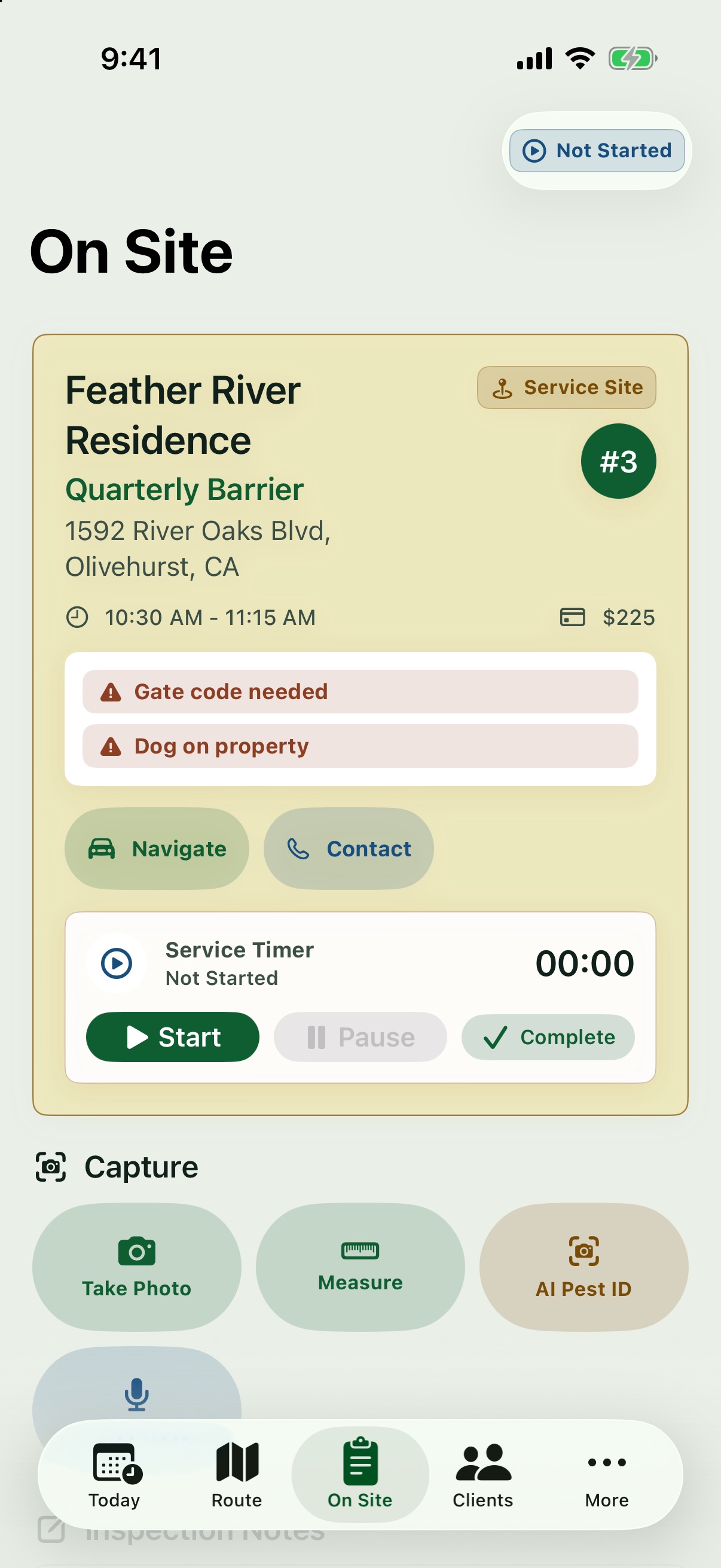
The trick isn't discipline — it's capturing during the work. Photograph findings when you see them, log materials when you apply them, take the signature at the door, and let the report assemble itself from what the stop already produced. That's the workflow Pest Route is built around: capture on site, review a drafted report, approve, and send — with nothing retyped.
Want reports that draft themselves from the stop?
Join the launch listFAQ
Should the report go out the same day?
Same visit, ideally — a report sent before you leave the curb reads as professionalism; one sent three days later reads as paperwork. If capture happens during the stop, same-visit sending is a button, not a burden.
Do photos really matter?
More than any sentence in the report. A dated photo of the finding and the placement is the difference between "we treated the garage" and evidence that you did — and it's the fastest way to justify recommendations a customer is hesitating on.
How long should I keep service reports?
Longer than you think you'll need to, and at minimum as long as your state and your insurer expect for service and application records — requirements vary. Digital storage makes "keep everything" the cheapest policy there is.