How to Research Yard Sale Items Before Buying
Research the exact item—not its most expensive cousin.
To research a yard-sale item before buying, identify it as specifically as possible, search with the details that affect value, compare the same condition and completeness, and separate active asking prices from evidence of completed sales. A fast search is useful only when the comparison is honest.
1. Identify first; price second.
Start with the maker, model, size, material, pattern, age clues, and included parts you can verify. Write the identity in one line before looking at prices. This prevents price anchoring: seeing a high number early, then bending every later clue until your item seems to match it.
2. Build the search from details that change the market.
Use the exact maker and model when available, then add the detail most likely to separate variants: size, capacity, colorway, material, production era, edition, part number, or set count. Remove vague words such as “rare,” “vintage,” and “valuable” unless they are part of an official product name. Those words describe a seller's argument, not the object.
3. Reject comparisons that borrow missing value.
A sealed item does not compare cleanly with an untested loose item. A complete appliance with proprietary attachments does not compare with the base unit alone. A professionally authenticated collectible does not set the price for an unsigned or unverified example. Every time your item differs, decide whether the difference changes demand, cost, or buyer confidence.
| Evidence | What it tells you | Common mistake |
|---|---|---|
| Exact model match | The strongest starting point for identity | Ignoring a size, year, or regional variant |
| Same condition and parts | Whether the price applies to your actual item | Borrowing value from a complete or tested example |
| Active listing | What a seller is asking now | Treating the ask as a completed sale |
| Completed sale, when available | Evidence that a buyer accepted a price | Ignoring date, shipping, condition, or outliers |
| Authentication or provenance | Why a specialist market may trust the item | Assuming a similar-looking item has the same proof |
4. Turn the price spread into a question list.
If similar listings range widely, do not average them immediately. Ask what separates the low cluster from the high cluster: tested versus untested, complete versus incomplete, common versus scarce variant, local pickup versus shipped, verified versus attributed, clean versus repaired. The spread is often telling you which fact you still need to learn.
5. Record confidence along with the estimate.
Write the range and a confidence label—high, medium, or low—plus the reason. “Medium: exact model, but untested” is more useful than a precise-looking single number. If the seller's price only works when every uncertain fact breaks your way, the research is already telling you to slow down.
Where Yard Sale Treasure Finder fits
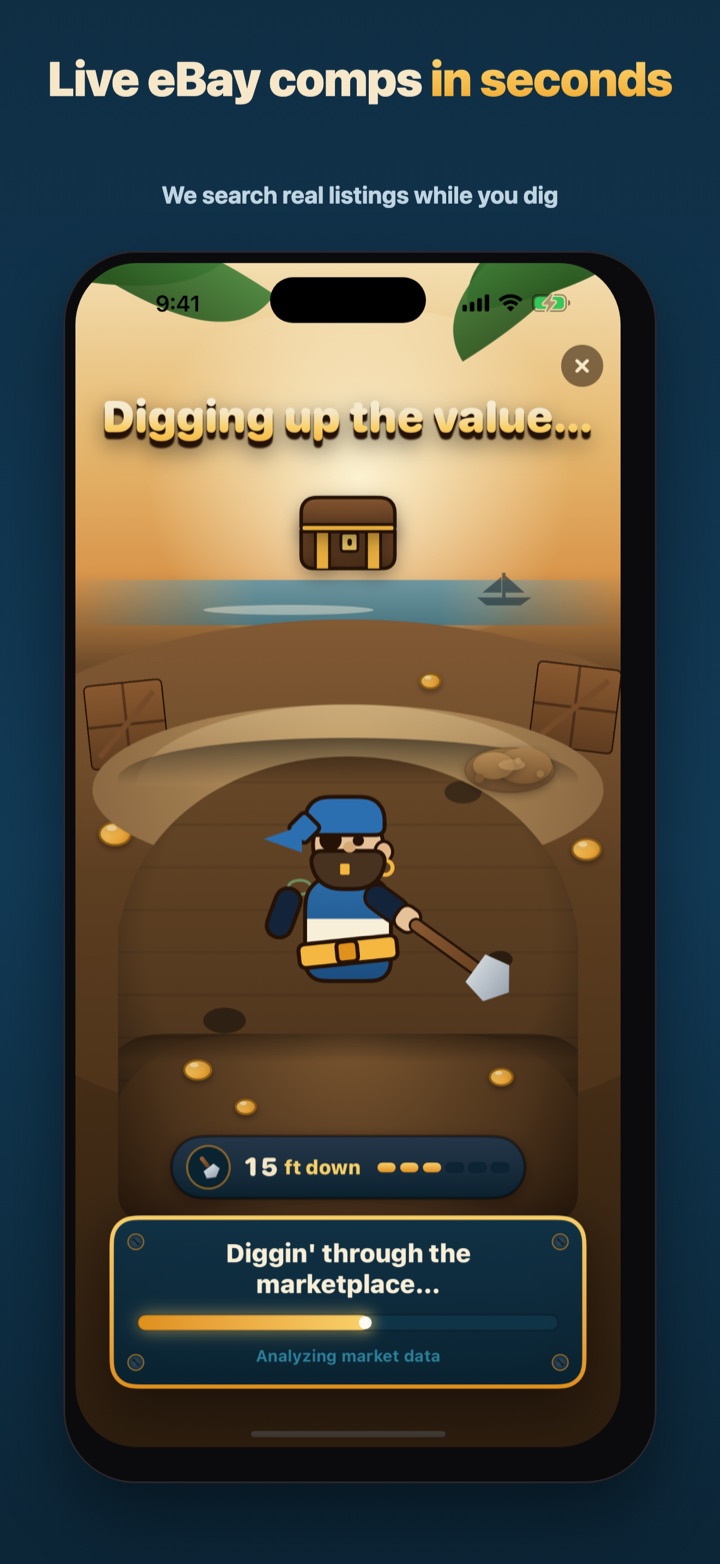
Yard Sale Treasure Finder combines photo-assisted identification with live eBay listing searches, then shows an estimated range and supporting comparisons. That can speed up the active-listing pass while you are still at the sale. It does not convert an asking price into a completed-sale result, and it cannot prove authenticity or hidden condition.
Need a faster first pass through live listing evidence?
Download on the App StoreFAQ
What if I cannot find the exact model?
Widen the search one step at a time: exact model, product family, then same maker and construction. Label any family-level comparison as lower confidence and reduce what you are willing to risk.
How many comparable listings do I need?
There is no magic number. You need enough genuinely similar examples to see whether prices cluster, which details explain the differences, and whether one unusually high or low listing is an outlier.