See every beat. Learn to read every ECG rhythm.
VitalSim Rhythm is a live, color-coded ECG rhythm trainer for nursing and medical students. Pick any of 27 rhythms, dial the heart rate, and watch the strip draw on a calibrated grid — with the P wave, QRS, and T colored so the beat finally makes sense. Then measure it, and learn every rhythm family with guided lessons and quizzes.
$9.99 · one-time · no subscription · iPad & iPhone
Works offline. No account. No data collected. Simulation only — not a medical device.
- Live rhythm strip
- All 27 rhythms
- Pro Vision color-coding
- Calipers & measurements
- Works offline
- Built by an RN educator
Rhythms blur together on paper
A page of look-alike strips is hard to learn from — nothing moves, the P waves and QRS all look the same shade of black, and the intervals stay abstract. VitalSim Rhythm turns the monitor into something you can drive: choose a rhythm, change the rate, freeze it, and measure it — with each part of the beat in its own color. It's a study tool with simulated waveforms, so it always points back to reading real patients with your team.
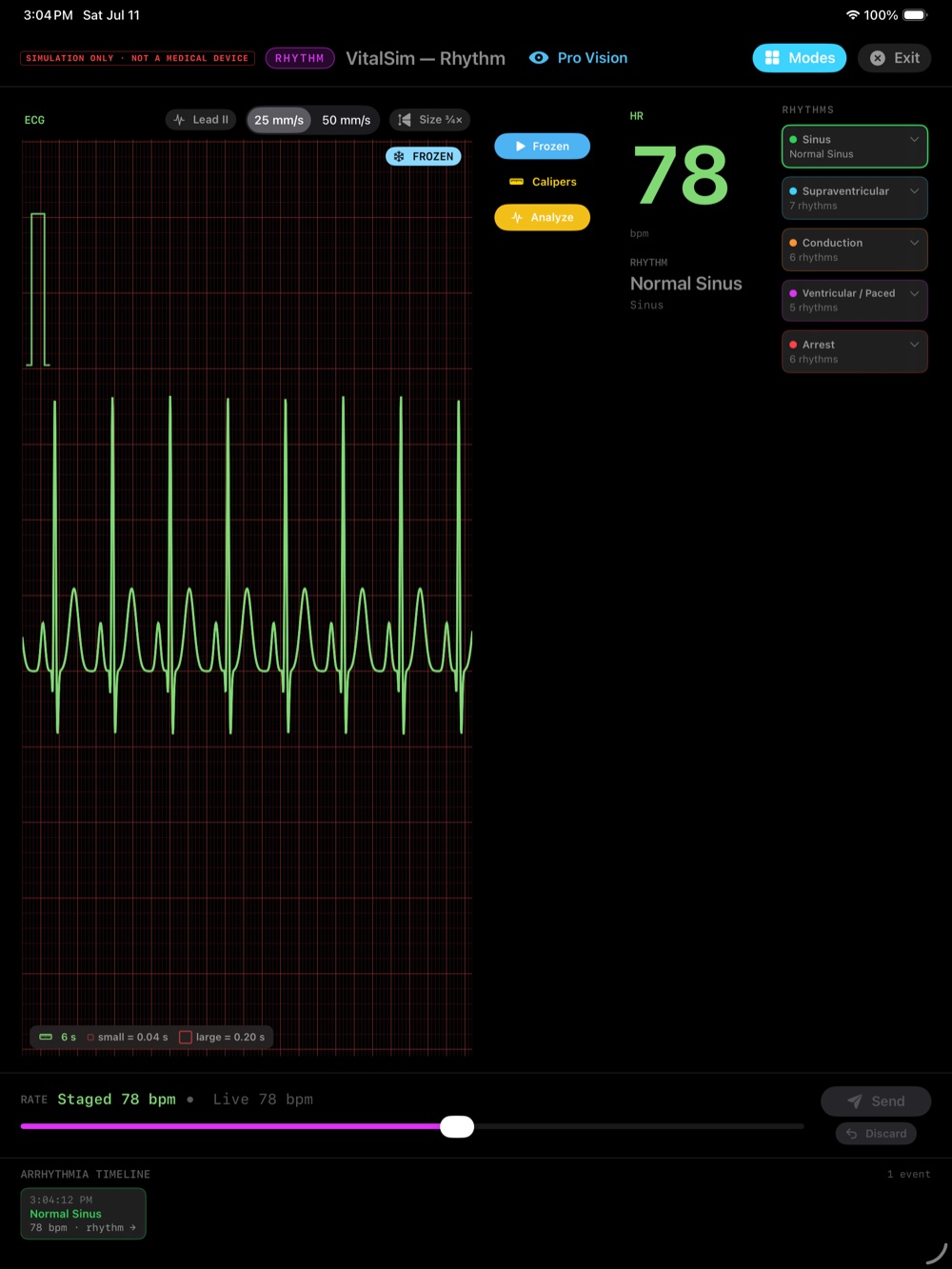
A monitor you can drive
This is a live, configurable rhythm strip — the kind you'll read on a real monitor, except you're in control. Pick any of 27 rhythms, dial the heart rate, and it draws in real time on an amplitude-calibrated grid. Freeze the strip to measure it with calipers, switch on Pro Vision to color the components, or open Analyze to check the intervals against your read.
Every part of the beat, in its own color
Pro Vision color-codes the beat so its anatomy is obvious at a glance: the P wave, the PR interval, the QRS complex, the ST segment, and the T wave each get a distinct color. Once you can see them apart, "P before every QRS," "wide QRS," and "long PR" stop being jargon.
- P wave · blue
- PR · purple
- QRS · red
- ST · orange
- T wave · green
VitalSim Rhythm's Pro Vision color-coding — one color per part of the beat.
What's inside
The trainer
- Live rhythm strip Pick any of 27 rhythms and dial the heart rate; the strip draws in real time.
- Pro Vision color-coding See the P, PR, QRS, ST, and T in distinct colors, with a legend.
- Calibrated grid & gain A calibrated ECG grid (small box 0.04 s, large box 0.20 s), adjustable gain, and 25/50 mm/s sweep.
Measure & check
- Freeze & calipers Freeze the strip and measure intervals with honest calipers.
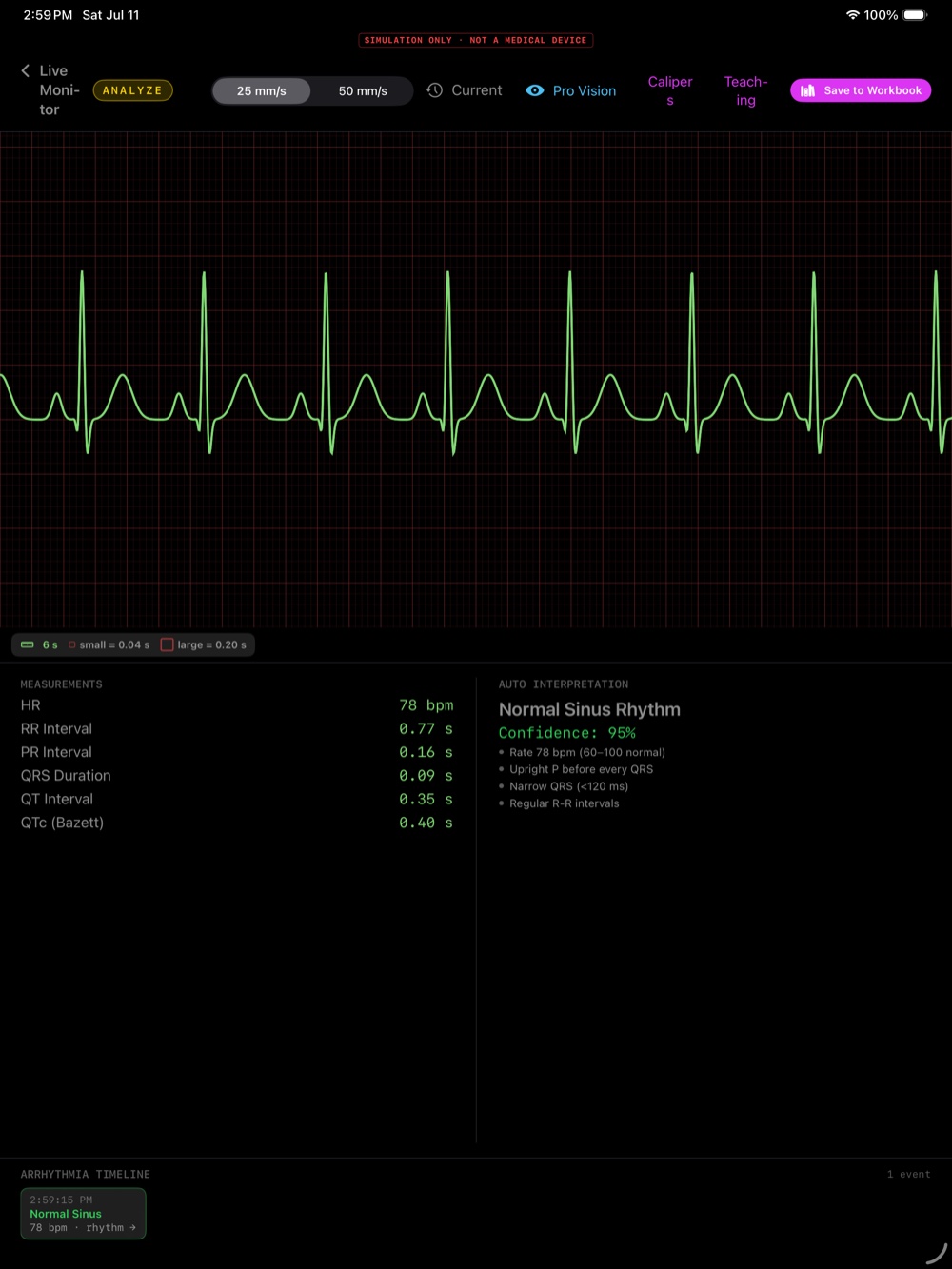
- Analyze Auto measurements (HR, RR, PR, QRS, QT, QTc) and an interpretation with its reasons — to check your read.
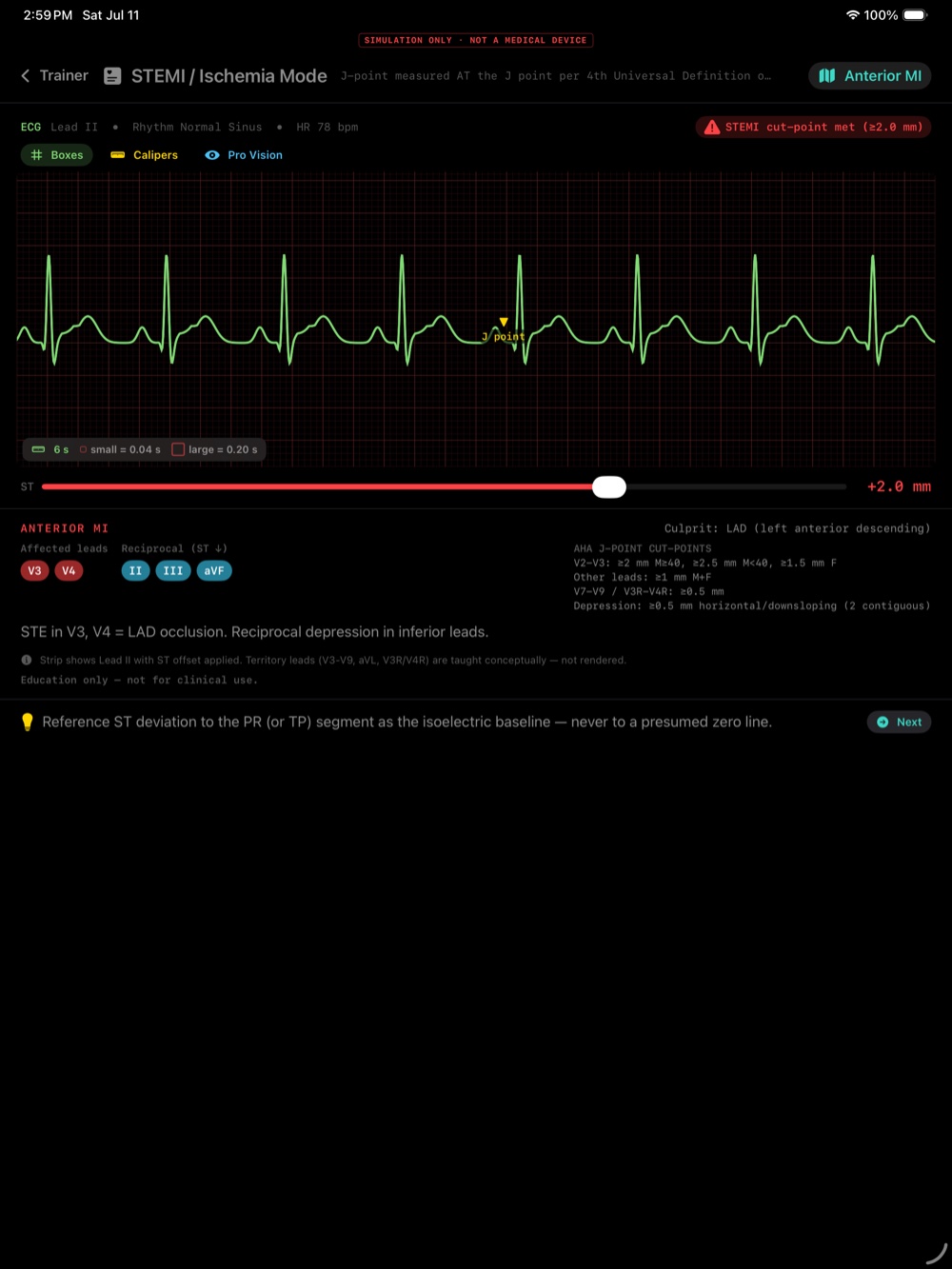
- Compare & 12-lead / STEMI Put rhythms side by side, and take your skills toward ST-elevation with a J-point / STEMI view.
Learn
- Lessons for all 27 rhythms A foundation track, five rhythm-family overviews, and a lesson for each of the 27 rhythms — with strip recognition, component breakdowns, and quizzes.
- Glossary & review loop A 367-term glossary in context, plus a review loop that resurfaces the rhythms you miss.
Yours
- Offline & private Fully offline, no account, no data collected; your progress stays on your device.
- Honest by design Simulated teaching waveforms, clearly labeled — education only, not a medical device.

See it in action
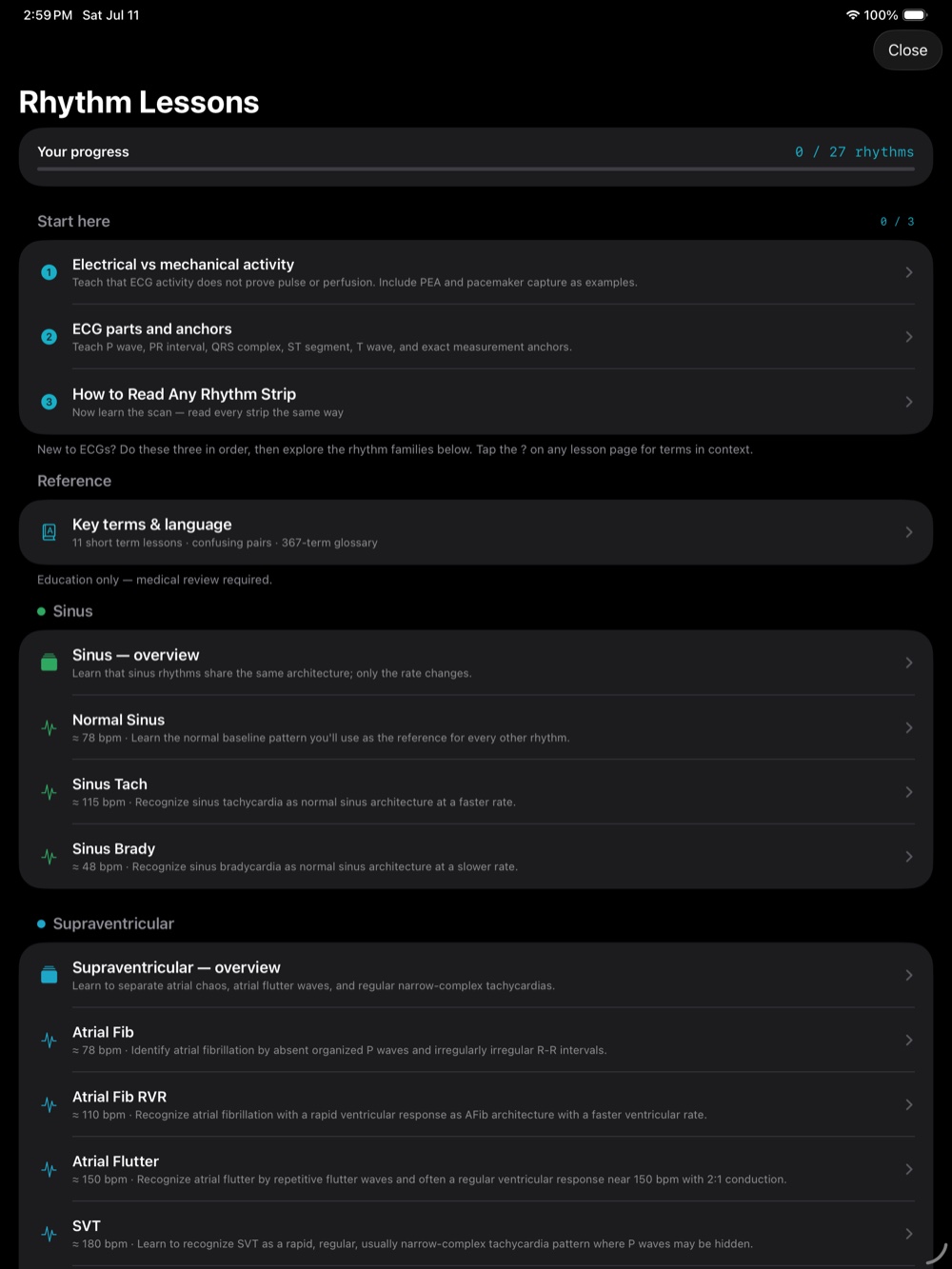
From "what's a P wave" to all 27 rhythms
- Start with the beat A foundation track teaches the grid, the parts of the beat, and how to scan any strip the same way.
-
Learn by family
Five overviews group the rhythms — sinus, supraventricular, conduction, ventricular/paced, and arrest.
- Sinus
- Supraventricular
- Conduction
- Ventricular/Paced
- Arrest
- Drill each rhythm A lesson per rhythm: recognize the strip, break down the components, measure, and quiz.
- Review what you miss A review loop brings back your weak rhythms until they stick.
iPad-first, and also on iPhone, Apple Silicon Mac, and Apple Vision Pro.
Made for the people learning the monitor
Built for nursing and medical students learning ECG rhythms for the first time, for new grads and telemetry techs who want to read the monitor with confidence, and for paramedic and EMS students. Whether "sinus rhythm" is new to you or you just want the scary rhythms to stop being scary, it's built for you.
Free ECG guides
Start with these plain-English guides, then practice them on a live strip in the app.
How to read a rhythm strip
The same six-step scan, every time.
Read the guide →ECG waves & intervals
What the P, QRS, and T actually are.
Read the guide →The cardiac rhythms list
The five families, and how to tell them apart.
Read the guide →Heart blocks explained
First, second, and third degree.
Read the guide →Dangerous rhythms
VT, VF, and the arrest rhythms.
Read the guide →Questions, answered
Is VitalSim Rhythm real ECG or simulated?
Simulated. The waveforms are teaching models, not real patient data — so you can dial up any rhythm and rate to study it. It's education only: not a medical device, and not for diagnosis or clinical decisions.
Who is it for?
Nursing and medical students, new grads, telemetry and monitor techs, and paramedic/EMS students — anyone learning to read ECG rhythms.
How many rhythms does it cover?
All 27, grouped into five families (sinus, supraventricular, conduction, ventricular/paced, and arrest), each with its own lesson, component breakdown, and quiz.
What is Pro Vision?
A color-coding mode that gives the P wave, PR interval, QRS complex, ST segment, and T wave each a distinct color, so the anatomy of the beat is easy to see while you learn.
Does it work offline?
Yes — fully offline, with no account and no network calls. Your progress is stored on your device.
How much is it? Is there a subscription?
A one-time purchase of $9.99 — no subscription, no in-app purchases, no ads.
Which devices does it run on?
It's designed for iPad first, and also runs on iPhone, Apple Silicon Macs, and Apple Vision Pro (iOS/iPadOS 26 or later).
Does it certify me or count for CE credit?
No. It's a study and practice tool. It does not certify you and does not grant continuing education credit.
Is my data collected?
No. The app collects no data, has no ads, and needs no account.
Start reading rhythms today
Get VitalSim Rhythm and turn the monitor into something you can practice on — a beat at a time.
$9.99 · one-time · no subscription · iPad & iPhone