The order, color by color
From first to last, the standard order is:
- Blood cultures: sterile bottles come first so the site is freshly prepped and nothing else contaminates them.
- Light blue: sodium citrate: coagulation tests (PT/INR, aPTT). Must be filled to the line.
- Serum: red (no additive) or gold/SST (clot activator + gel): most chemistry and serology.
- Green: heparin: plasma chemistry and stat chemistries.
- Lavender: EDTA: CBC and most hematology.
- Gray: sodium fluoride / potassium oxalate: glucose and lactate.
Some facilities also place royal-blue (trace metals), tan, yellow, or pink tubes at specific points. Your lab's test directory is the final word.
Why the order matters: additive carryover
When the needle passes through a tube's rubber stopper, a microscopic amount of that tube's additive can cling to it and carry into the next tube. Draw a heparin tube before a light-blue coagulation tube and that carried-over heparin can skew the coagulation result: a classic cause of a redraw. The order is built to move from "no additive" toward additives that would most disrupt the next test.
A mnemonic (but understand it, don't just memorize it)
A common one is "Young Bodies Really Should Get Large Grains": Yellow (culture), Blue, Red, SST/gold, Green, Lavender, Gray. Mnemonics are great for exam day, but the phlebotomists who never mix up a tricky order are the ones who understand carryover and know which additive belongs to each tube.
Special cases & facility policy
The order can shift for winged (butterfly) sets, discard/waste tubes, special microbiology, and some send-outs, and a few facilities publish their own order. Follow your employer's approved policy and your laboratory's test directory whenever local practice differs from a general chart.
Practice it in the app
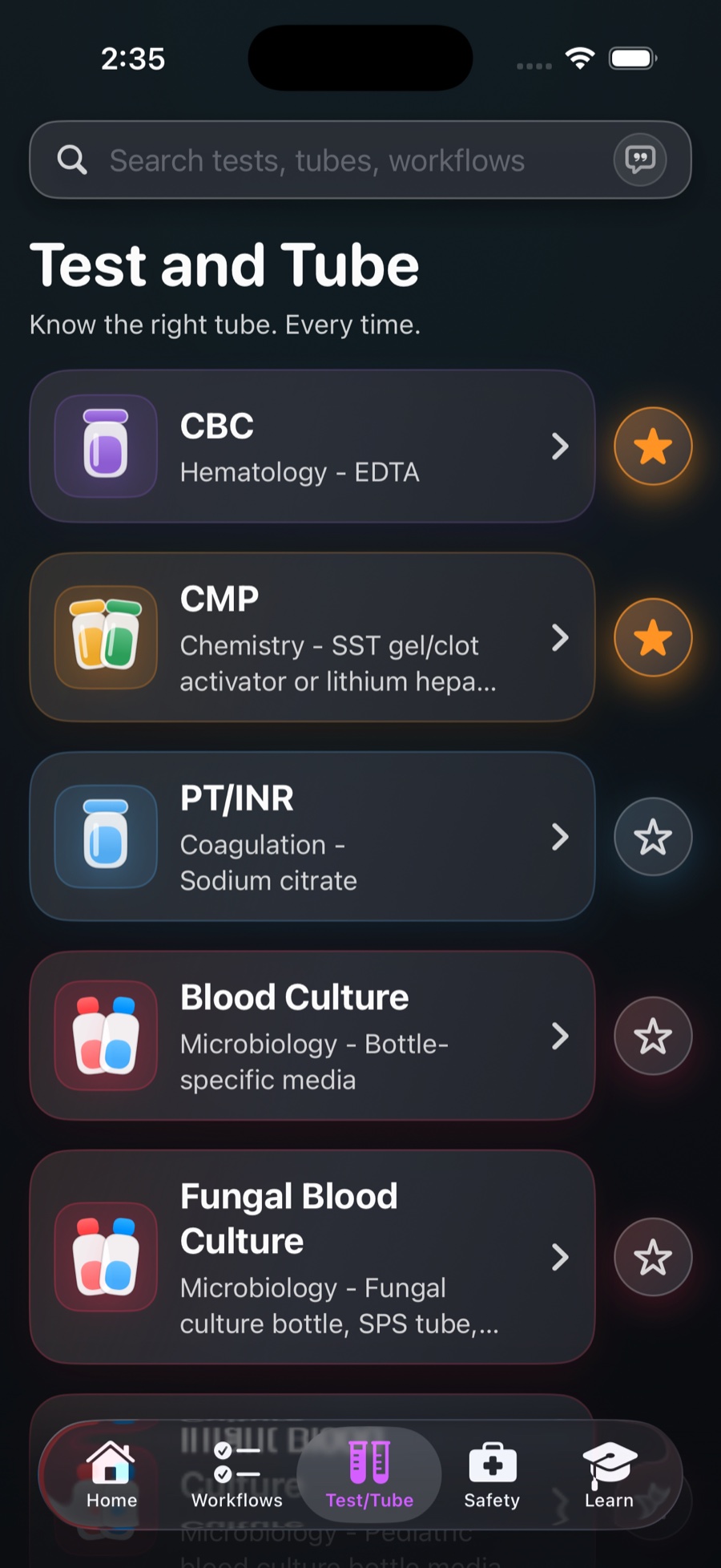
Phlebotomy Toolkit shows the order of draw with color-coded tubes and links each tube to its tests, additive, and handling, so the sequence sticks. It's offline, so it's there at the draw chair or on the bus to your exam.

$9.99 · one-time · no subscription · iPhone & iPad